In this current climate of black and white thinking (progress vs tradition, femininity vs masculinity, freedom vs law & order, strength vs vulnerability, peace vs war) and an extra dose of gaslighting propaganda, it is not surprising that in some circles empathy and compassion is derided as some of sort of “weak, feminine, sentimental and misplaced” emotion. This should not be surprising in a hierarchical patriarchal society. But these seemingly opposing qualities when used in a healthy way give balance and a stronger foundation. They are not opposing forces but complementary as one quality supports the other. Cultural attitudes and belief systems also give these words rigid meanings meant to fit in with agendas. We live in a time when strength is seen as loud dominance, might makes right, hardly a new phenomenon. But when a tornado blows in, the real strength is in the aftermath, seen as a quiet fortitude, self discipline and equanamity that does not comply out of fear or selfish aims, but is able to see the long view. Empathy combines emotions with thoughts undergirded by a moral framework.
In fact a healthy society and a healthy life needs balance these traits to survive and thrive, although misperceptions of what these traits is problematic. For example some people may think that being gentle (feminine?!) is fragile, when it may be exactly what is needed to reach a goal. But being gentle is a measure of self discipline and self discipline is hardly fragile. Life is a mix of qualities that should flow, not divide. Vulnerability for example requires strength in the form of courage. Dividing feminine and masculine energy traits becomes increasingly nonsensical the deeper you go, because in truth everyone has access to these energies. Freedom requires law and order to be in service of justice, and security buttresses freedom; law and order without freedom is merely oppression and life soon loses it vibrancy and creativity. Tradition always starts as something new (progress) and provides context and understanding; traditions that lead to fear of change becomes meaningless and robotic routines, and often maladaptive. Life is built on systems, and systems are about connections, roles, discrete and overall purpose and goals. Many examples abound of one thing in a system going wrong ruining everything else, but also of things going right. Empathy by the way is not a lack of boundaries, in fact boundaries can provide clearer purpose.
Some people may have a seemingly inborn nature that provides fertile soil for empathy and compassion, and teaching small children how to be more empathetic is not only possible but important. But people are on a spectrum, differing temperaments shaped into personalities. Culture, which includes social norms and public policy may also encourage how how this plays out. Individualistic cultures versus communitarian or collectivist cultures, expressed in customs, economics, politics and community has an impact of how empathy and compassion is expressed and treated. In the U.S., in our individualistic, capitalistic culture hyper competitiveness and narcissistic traits are encouraged in different spheres, including politics, business and sadly religion. These traits often appear as charisma. Too often appearance is valued more highly than other things, perhaps its human nature, perhaps it is just easier. [Why else would be people make a comment regarding a tragic death of an unknown woman, saying “she was pretty”]. This is obviously made worse by an incessant need to be seen, to be viewed as popular (as if popularity was an important metric of value) and vanity is preferred over boring humility. Loudness is too often confused with confidence, and confidence is confused with being right. For these reasons being empathetic requires strength.
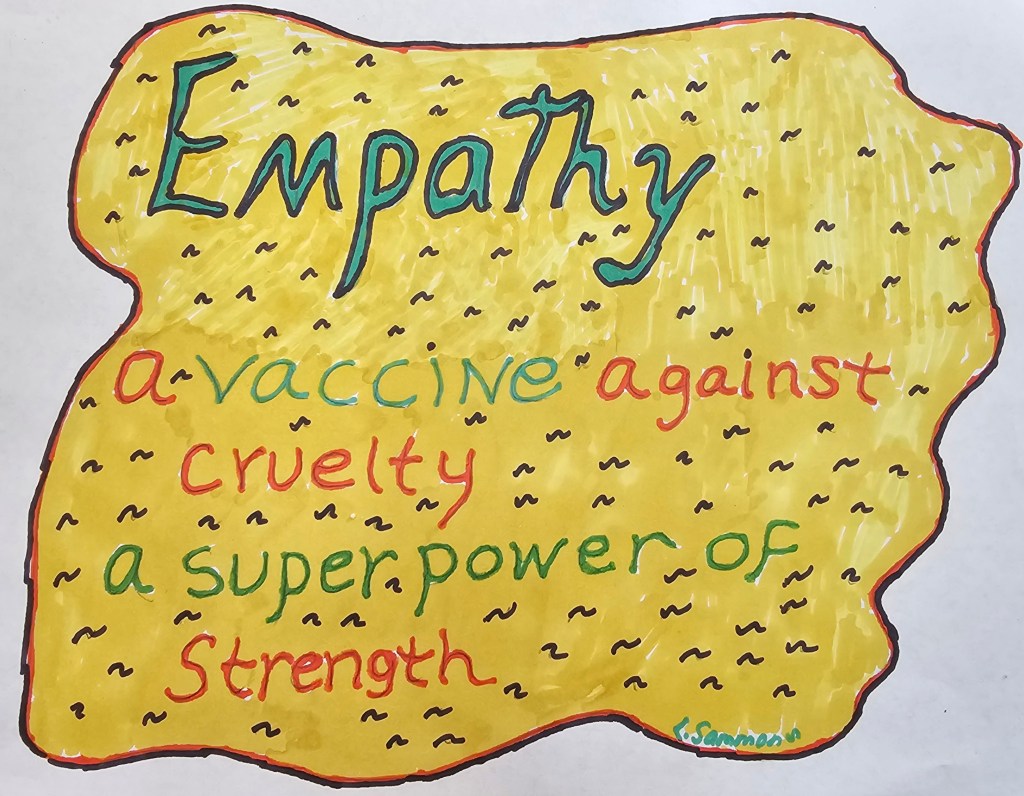
Empathy and Connection as A Source Of Strength
Too often there is a failure of understanding of how life works and what empathy and compassion means. Life is about commonality and differences, harmony and disruption. Life is a balancing act, as we observe, between stillness and movement, rest and growth, a constant state of choosing and adapting. Empathy can bridge these gaps and connect thoughts and emotions in a coherent and deeper way. Empathy and compassion is another way to express love and kindness, from a deep well of strength, which in turns provides both enjoyment and endurance. The opposite states are paranoid fear, hostile anger, and even indifference devolving into chaos and destruction. Empathy and compassion is part of connecting with other people. Connecting with others can be in moments of deep sorrow, can be moments of much needed laughter. It can be a little of both. It is even more needed in this moment when great harm is being done, because harm is magnified in isolation. In terms of science and biology as embedded in nature human connection (that includes introverted me) empathy is imperative for survival and thriving. Many animals have and need connected social lives, and often appear to feel empathy, and no just for their own but other animals, including people. So nature is a well spring of connections, cooperation and empathy, alongside competition. It should be noted that connection does not require proximity and empathy can be felt toward what is far and foreign.
My First Stirrings of Empathy
My first, rather childish experience with empathy was when my mother gave my eight year old self an assignment, to go give a get well card to my 13 year old babysitter down the street. As I was wont to do, I took this seriously. I was introverted and creative with an active imagination, sensitive to my environment, so I valued my quiet after school before plunging back into my noisy, big family and the neighborhood. (Note: the word introverted was not yet in the general vocabulary, I just knew what I needed). As I I walked down the middle of the street toward her house on a nice Saturday afternoon my friends began to tag along. I was on a mission, they were having fun. What’cha doin’? Where ya goin’? I could not shake them, especially my best friend, who was quite bossy and confident. We approached my babysitter’s house, on the corner, a green house with shady trees. Greeted by her mother (whom I barely acknowledged) I went through the living room, down the hall, trailed by my entourage, to her bedroom at the end of the hall with her window looking out the back yard. The room was small (our houses were small). She was in bed, covered up to her shoulders, her red hair strewn over a very white pillow case. I presented my card. My group was quiet now. The mission had been transformed into something different. I was no longer a missionary. Deep in my bones I understood I was witnessing something profound. A young girl now crippled with juvenile arthritis, as my parents explained later. She smiled faintly and accepted the card. I could hardly speak, not because of my shyness, but because of my overwhelm. I had my own physical limitations, but my understanding was not about that, but about something deeper. It was not that long ago she was caring for me, and now she required care. Later she moved to Arizona, away from Southern California coast. That day left a deep impression on me.
Aspects of Empathy
Empathy and compassion are not superficial mindsets. These can show up as kindness, honesty, and often really hard work. (Anyone doing intense caregiving knows this). Kindness is about honesty, even if its raw or hurts a bit. As a therapist along with empathy is being genuine. As I write this, I am providing care for my husband at home as he receives intensive cancer treatment. At times when I am focused on healing goals, I need to remind myself that some days he is not resisting, he is simply uncomfortable. I know what this feels like. In my therapy work I may provide comfort, but it is my duty, and my way to share my truth, based in ethical practice, even while learning about and acknowledging someone’s perspective and background, which may be much different than mine. It is not about bluntness or harshness, which may feel like an attack, and only serves to put up defenses. It is about breaking down barriers. But empathy can bridge the gap not only with understanding, but remembering that we all have sufferings, we all have longings, and and we are all trying to find our way in the world. It does not mean fixing. Empathy, as I have experienced it, can have a strong physical component. I have certainly experienced others pain in my body. It can also feel intense, and quite personal. It may have an intuitive feel to it, not requiring a lot of planning, but intuition arises out of not just personality but experience and practicing skills. Empathy feels, compassion puts the feeling into action.
Empathy should get past preconceptions, prejudices, assumptions and superficial niceties. It should be the beginning of a deeper understanding, and in turn with compassion use that understanding should lead to actions. This gives it a deep power. Too often thought people do not notice or understand the suffering of others unless it affects them personally. This is why feeling empathy can be so important in social or political arenas. A lack of empathy, of caring, risks nihilism. For these reasons its not felt just for people you know, but for people far away. It can in fact help to foster social movements. However it should be embedded in a good sense of self. As a sensitive child I felt the beginnings of empathy, compassion and connection, but I was not yet in understanding, which actually took a long time. My understanding was furthered by times of trauma and getting past trauma. Not without missteps and confusion. But missteps and confusion can be a pathway to clarity.
Empathy as a Path Out of Chaos and Fear
While empathy can provide understanding, comprehension and knowledge is aways partial. Knowing this helps to avoid hubris, pride and self righteousness. At the most basic level all people value security, a sense of belonging, love, and sometimes spirituality and service to others. Unfortunately for some people, perhaps due to trauma, personality disorders, or simply an upbringing rooted in different values, these needs are expressed in harmful ways. Because we live in a time that seems to value narcissistic traits in power circles empathy and compassion are seen as weak or ineffective. Empathy and narcissism are in fact exact opposites to each other. But empathy and compassion that is undergirded by a moral framework allows the ability to see what is evil and fight for what is good, and to stand up for those who are being traumatized by evil. Thoughtful empathy and compassion can provide clarity in the midst of chaos. Clear, unafraid communication can cut through the noise and chaos (in other words B.S.) and provide guidance for others. Empathy is burdensome, it is not for the weak. Empathy that results in compassionate action is not a performance nor a greeting card. But it can be used as an example, to show not just tell. It does not even require the recipient to know. There are countless examples where one empathetic and compassionate person made a difference for others.
Empathy and Compassion in Action
Empathy and compassion in one individual is empowering. As a collective, in which actions come out of this mindset, change can happen. It has happened before. It is effortful. The Monks are doing a type of walking meditation, which provides a sense of grounding. Walking within community provides the connection. They are also walking with an aim, toward a destination, which gives them purpose. Moreover there are walking in full awareness of the ways of the world, the good and bad. They are not naive or gullible, they know they may be walking into the Lions Den. This gives them a naturalness, confidence and ease that can be disarming, especially in this time of turmoil.
As a little girl I did not yet know a lot. But obviously that moment left an impression on me. For a moment I was in that moment. It was another step in my sense of self, and awareness of the world, even if it was not conscious. We cannot lose hope. Right now discernment, perspective, and yes even some patience is needed. This does not mean you avoid actions, but take wise actions rooted in understanding. Empathy and compassion need nourishment of a growth mindset that is flexible, rooted in values, and building of hope and (realistic) expectations. Enough growth should help crowd out the noxious weeds, although there is still a need to actively fight against these weeds. (In nature there is nothing inherently wrong with weeds, but as a symbol of evil in inhumanity they need to be rooted out whenever possible). Use all of your masculine and feminine energies, and perhaps a touch of the innocent idealism I had as a child, but in the framework of realistic expectations. A healthy community and society should encourage empathy and compassion, and the right actions that follow. Group actions can even be more powerful in conveying what is true to stop injustice. As a individual, every day, you have a chance to do the same.
I have not mentioned love, but empathy provides depth to love. Love means loving life, even when its scary. Especially so. Empathy creates a spark, the spark starts a flame of compassion, lets keep the chain going in these dark times.
I wish you peace and strength.
 easydoesitlife