No surprise, as millions around the world were loving the Peace Walk by Buddhist Monks, doing a monumental trek from Texas to Washington D.C., the press and politicians continue to be focused on…. the drama and spectacle coming out of Washington D.C. and elsewhere. When the New York Times finally, a few days ago, deigned to cover this story, it somehow seemed like an assignment from their editor (“do a story on this”). The writers seemed kind of bored, I suppose they did the five W’s I learned in my journalism classes ages ago. What’s a shame is that they missed the undercurrent, that people from many different backgrounds and perspectives seemed hungry for the story the Monks were telling. Reporters may continue to be enthralled by the moment-to-moment drama, and yes what is happening is consequential, but I also feel like journalists should be a bit more curious. Should that not be in their job description?
I admit to some bias because as much as I enjoy being enthusiastic and cheerful, even laughing till I cry (it’s been a while since I laughed) my introvert and introspective side appreciate quiet and intentional living. In a distracted time, I can only take so much stimulus. It’s not that I don’t like having fun. I also appreciate dark humor; we needed this when I did my ER work. But this era does not seem like much fun anymore, unless somebody enjoys being constantly in a rage or belittling others. I also confess to harboring some qualms concerning anything sales (I don’t like to sold, if I want to buy, then I will) or anything to do with reality shows (partly because my late husband was on the national board of SAG for a long time, and union actors really don’t care for so called “non scripted” reality shows).
Politics often has a feeling for both sales and a reality show. I suppose because people (including the press) become bored if things are not sufficiently exciting. As a prescient Neil Postman wrote, we are amusing ourselves to death (1985). Why the need for constant three ring circus? Or perhaps the need of some to see the car accidents, crime stories, and just overall bizarreness. On the other hand, I suppose thousands of years of gossip, from villager to villager, broadsheet to broadsheet, headline to headline, meme or meme seems to a constant in the human condition. If it bleeds it leads. Bottom line is emotions drive a lot of our motivations. When emotions take the driver seat, then perspective and empathetic understanding are left mute in the back seat.
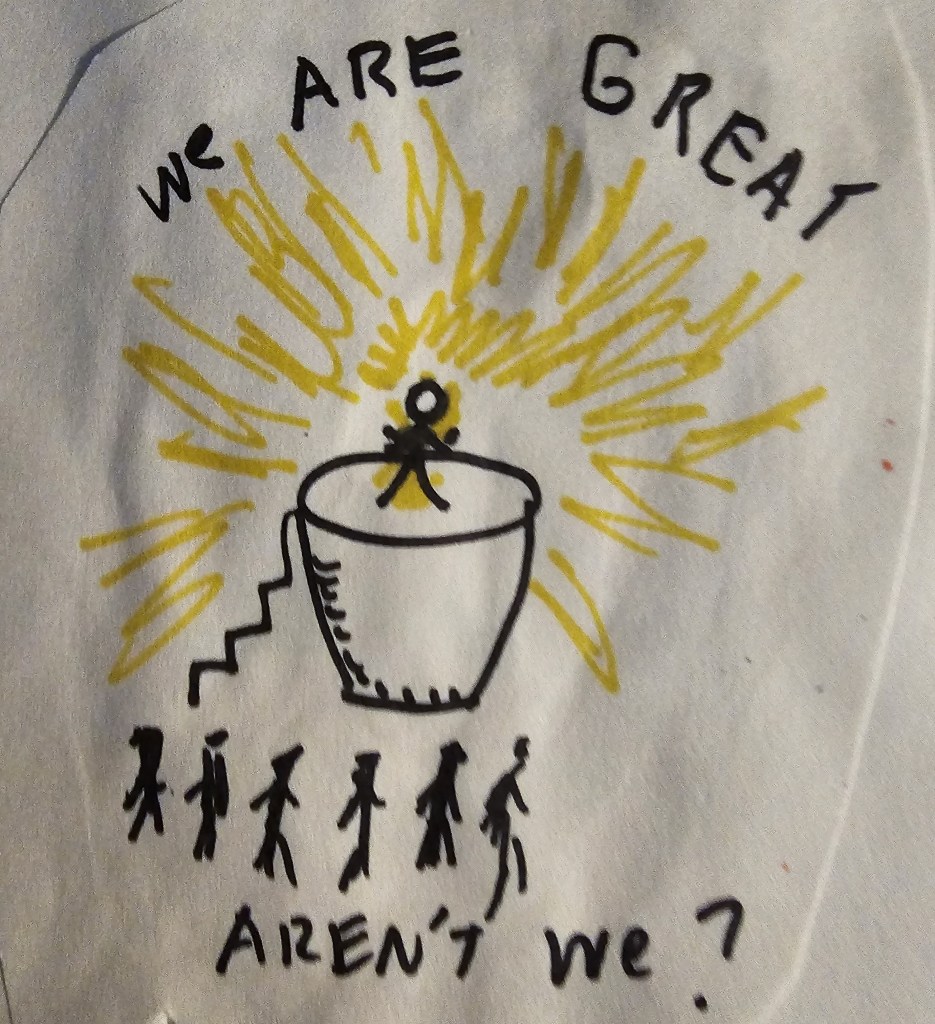
I mean does not life have its own inherent drama, its own roller coaster without creating or seeking it out? Not that people should keep their head in the sand. And of course there will always be people who love taking outsize risks. Certainly public dialogue aka “marketplace of ideas,” as discussed by John Stuart Mills (1859/1985) and coined by Oliver Wendell Homes in Abrams vs United States case (1919) is or can be healthy. But when you go into a market do you want it to be a constant free for all, with people throwing bananas and cans around, or does seem more fruitful (!) to check out the aisles and bins on your own accord. The other problem is that if the disorder becomes overwhelming then someone will use it as an excuse to bring in oppression in the guise of bringing order. Order coming out of peace should bring harmony, harmony implies some differences, if anyone understands music. To take a holistic view, nature does this well. There is a pattern and harmony, following underwritten “rules of nature” for the individual and overall good. Nature shows this in the changing of seasons, in differences and commonalities, in connections and cause and effect, in adaptive change, in birth and death. In other words, harmony is health.
Life often “feels” random, confusing, and overwhelming. Human brains seek out patterns, even in the randomness or perhaps because of the apparent randomness. Sometimes this pattern seeking leads ignoring other things coming along, or in some cases conspiracy thoughts. All of this is because people actually do want a sense of security. But people are terrible at predicting happiness, and wanting security can lead to traps and self-sabotage, and this fear often results in wanting distractions, attacking others, and wanting to feel better than others. Salespeople, business leaders, politicians know this well. (Note, yes there are ethical salespeople, but in our money driven, late-stage capitalism times it is getting harder to find).
A flattening of views, from on high, is actually disharmony, because there is no reflection, no real peace. It is a distortion. I suppose this is where the ideas of civil society come in, to be okay with disagreement, in fact to not be fazed by it, but to come from a place of deep principles. I understand the frustration, resentment and feeling shortchanged really well, but unfortunately the attention always seems to focus on the venting and not the injustice. The Venerable Monks demonstrated this perfectly during their walk, which kept them connected to the ground, and kept them centered no matter what was going on.
You can lose perspective and discernment if you don’t retreat a bit, respond thoughtfully without putting reactions on auto mode. (Which is why I NEED to quit looking at “news” feed comment sections, I swear it is starting to feel psychotic).
I have long appreciated the ideas found in Buddhist practices. Effective therapy practices such as Acceptance Commitment Therapy integrates some Buddhist principles. Acceptance and acknowledgement are the opposite of denial, a basic principle used in 12 step programs, but not so much in politics. I should also note that as a social worker I definitely understand the importance of not only social justice but advocating and fighting for social justice. Fighting for social justice is not just getting angry, but needs to be purposeful and effective, or at least that is what I learned in school. An orderly society should not only provide safety, but be rooted in values that show respect and understand the dignity of everyone.
So often people think that being strong and powerful is about being dominant, big, loud, steely, intimidating, bossy, confrontational, competitive, rigid, self-centered, extreme, fast, fearsome with a strong gravitational pull that attracts and diverts attention and has a win or lose ethos. In our individualist fast moving culture the extroverts appear to take the room and the stage. Don’t get me wrong, I enjoy extroverted people. But I guess plenty of people are drama addicts. All the world is a stage as he wrote. But does the drama have to be so melodramatic? And currently why is it so hard to tell if something is satire or not? What would Mark Twain or Jonanthan Swift be thinking?
Now of course the ethos of power, and everything that goes with it, in all the usual realms (government, business, religion, academia) has been around forever. It is like a smoggy or foggy day that does not lift. Eras and periods reflect social mores, which are in turned tied to cultural, economic, and political systems, and now currently topped off with attention grabby social media. There is certainly a strong flavor of narcissism now, but perhaps that has always been there is you use a casual definition of destructive self-centeredness. [Note as an LCSW I remind readers that narcissistic personality disorder is a well-defined set of traits right out of the DSM and I don’t care for the casual use of it to describe other people in every circumstance]. It also feels like many of us our swimming in a sea of anxiety all the time, but maybe I am projecting.
In an extroverted, hypercompetitive society I suppose that loud and flashy will be mistaken for important, crucial, even truthful, which means people miss important undercurrents. But it’s important in life and society to have room for resiliency, moderation, introspection, steadiness, perseverance, courage, caring, understanding and humility in which the focus is on intention, nor attention. Historical narratives, political and business coverage, even coverage of seemingly good things often focus on what grabs attention. Institutions such as religion seem to prop up this view, with an emphasis on spectacle and ritual, and of course worship. People of faith may somehow view God as huge and powerful, like some sort of supernatural Wizard of Oz, giving tokens or punishment, a reflection of patriarchal ethos. I guess there was a reason why hangings were a public spectacle.
An important source of perspective come from writers, artists, musicians, philosophers, teachers, scientists and anyone who can provide some depth and discernment. Fresh ideas are needed; however, the truth is fresh ideas are usually ideas that are rediscovered. For example, Stoicism has a lot to add to the conversation, if we can hear above the din. One stoic example is forgoing the need to have or at least share your opinion about everything under the sun.
If looking at life as a constant battle to win or lose is your thing, have at it. Plenty of people to join with or fight against. I am not saying withdraw or be a mere spectator at the arena. If you are in the arena, then make sure you are steady in your purpose. The Venerable Monks were focused on their walking meditation during their 108-day journey from Texas to Washington D.C., but people noticed and sought them out.
May you be safe, well and happy.
References
Abrams v United States, 250 U.S. 616 (1919) Free Speech Center
Mill, J.S. (1985) On liberty. Penquin. (original work published 1859).
Postman, N. (1985) Amusing ourselves to death: Public discourse in age of showbusiness. Viking.
 easydoesitlife